
Product · phone and PC
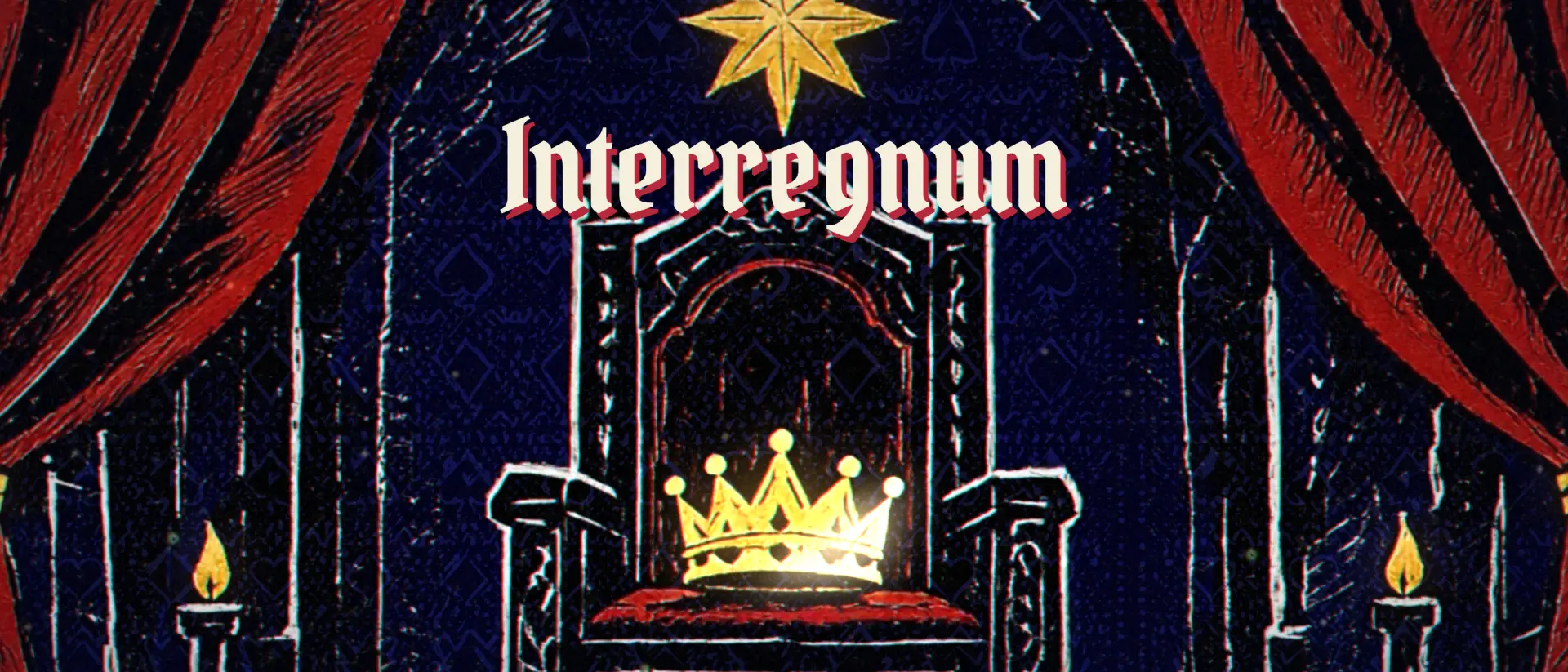
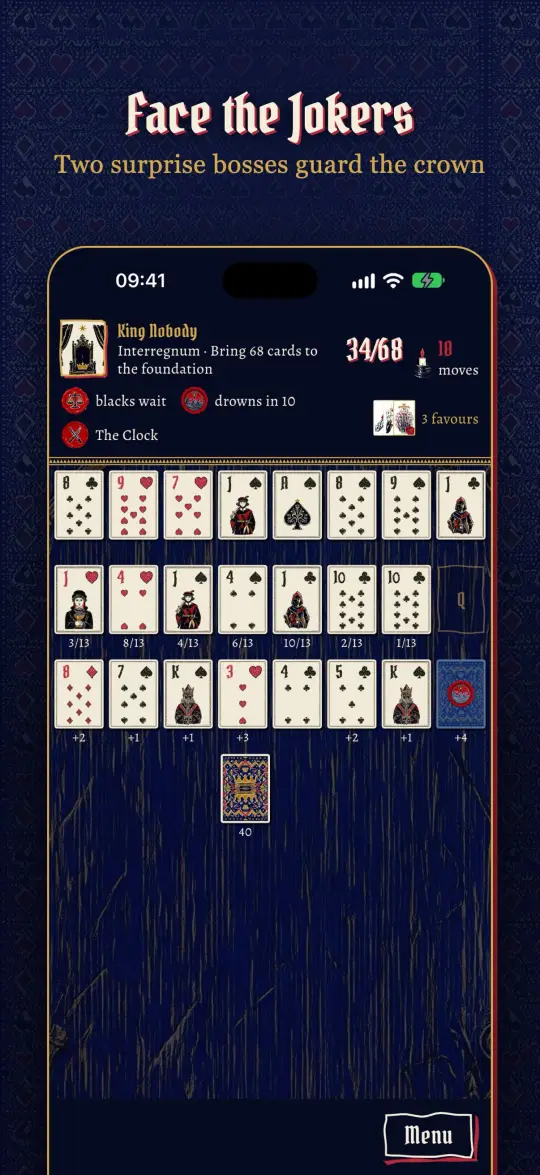
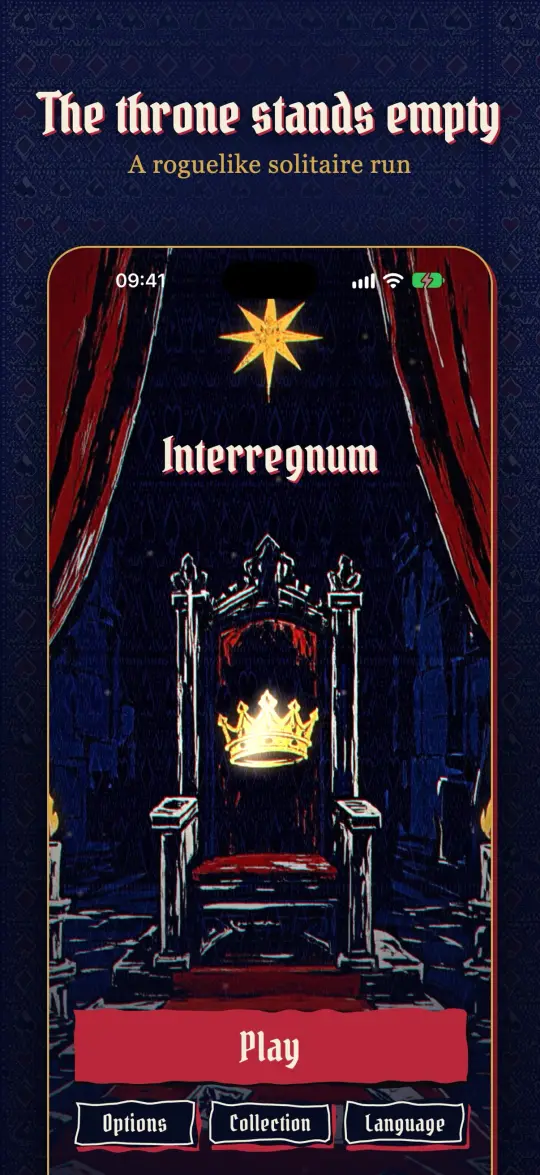
A roguelike solitaire. In every suit you topple the Jack, the Queen and the King, one classic solitaire per table, and then you face the two Jokers guarding the empty throne. Fail a challenge and the run is over, back to the start.
One run
-
The court
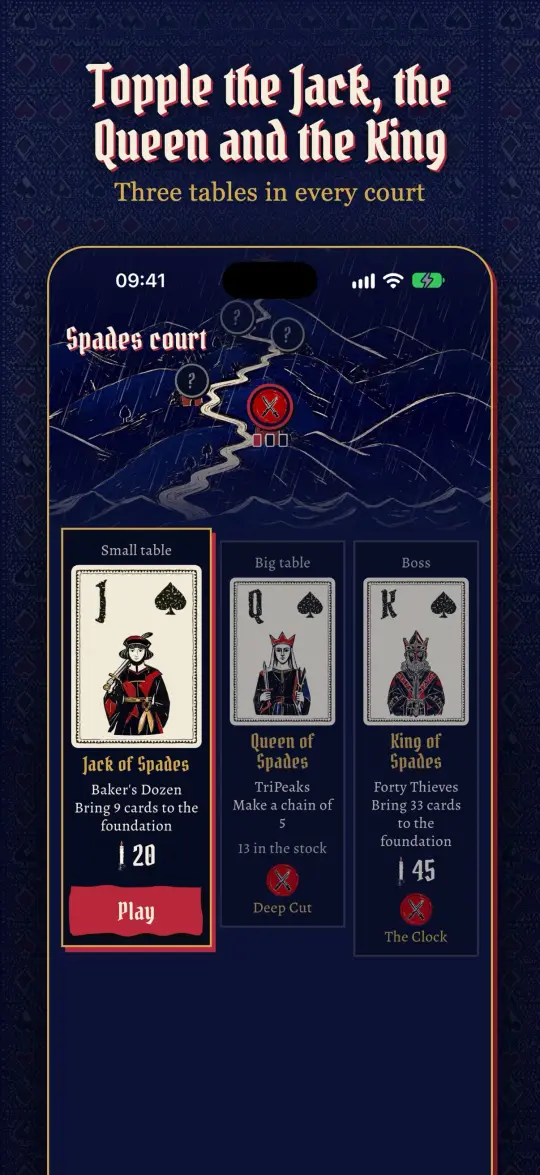
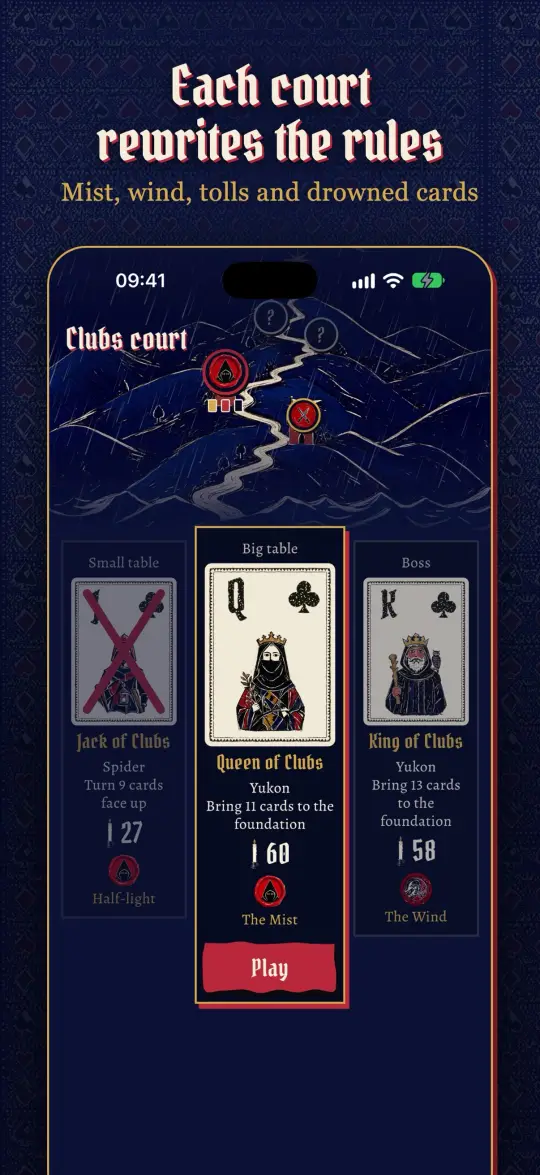
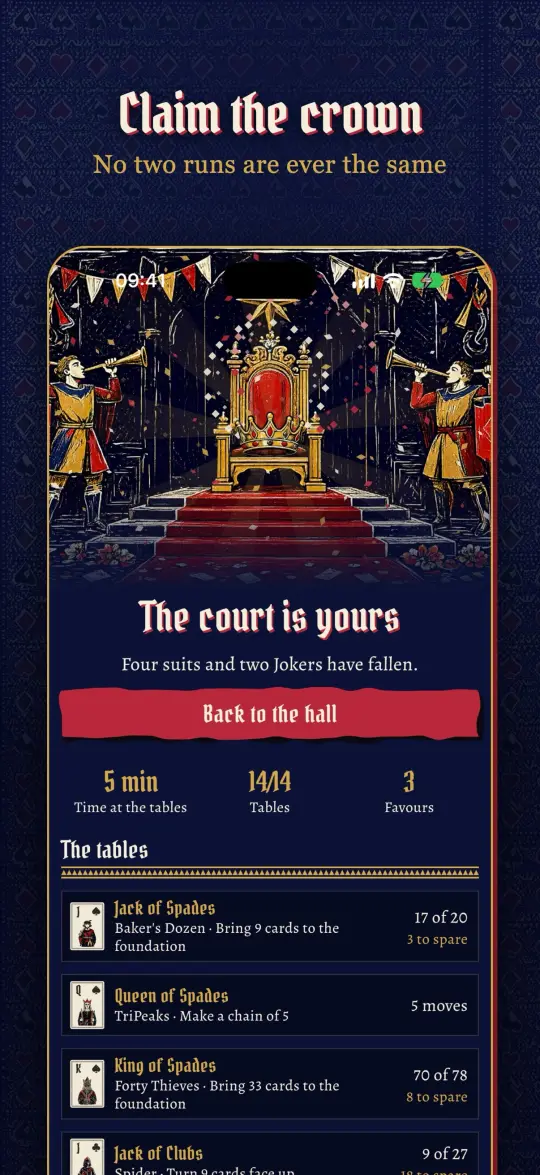
Four suits, in a shuffled order, three tables each. Every court rewrites the rules: mist, wind, tolls and drowned cards.
-
The table
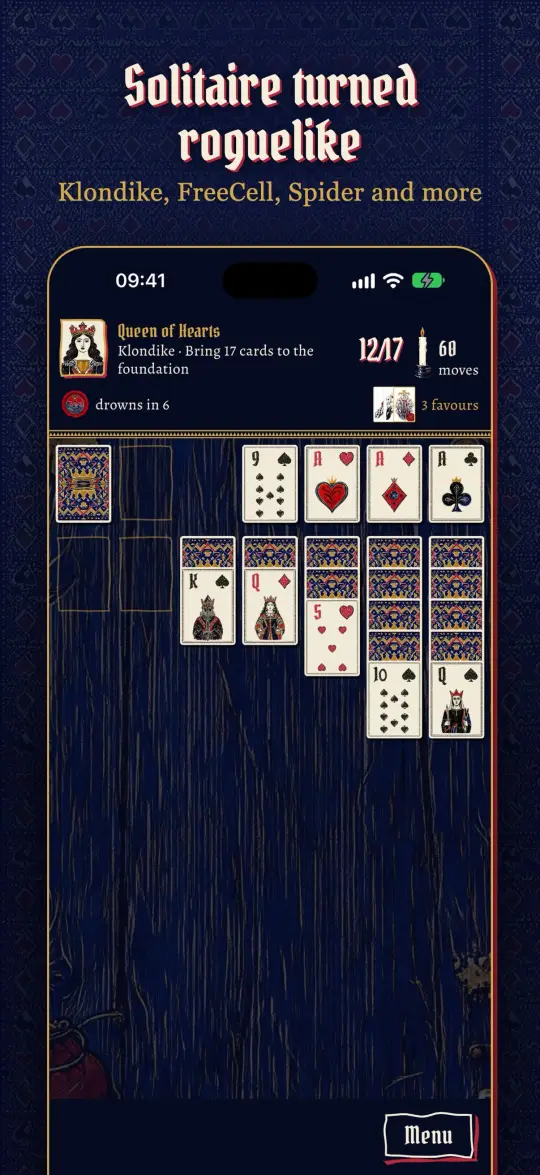
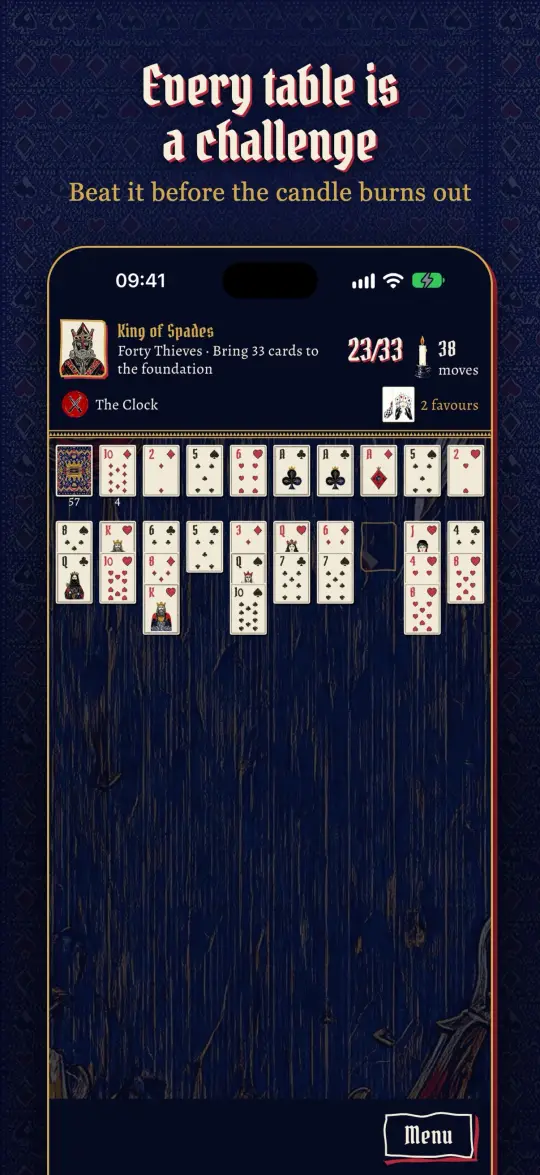
Klondike, FreeCell, Spider, TriPeaks and sixteen more. Every table brings a challenge, and the candle counts the moves you have left.
-
The favour
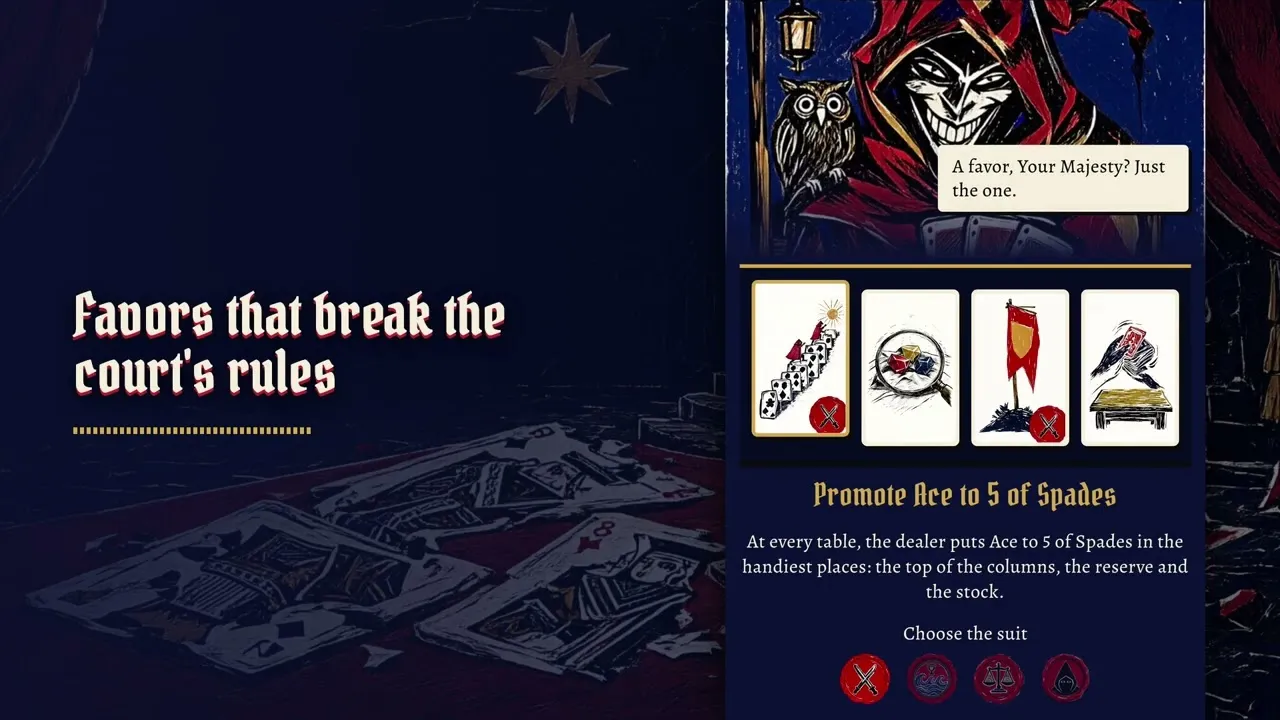
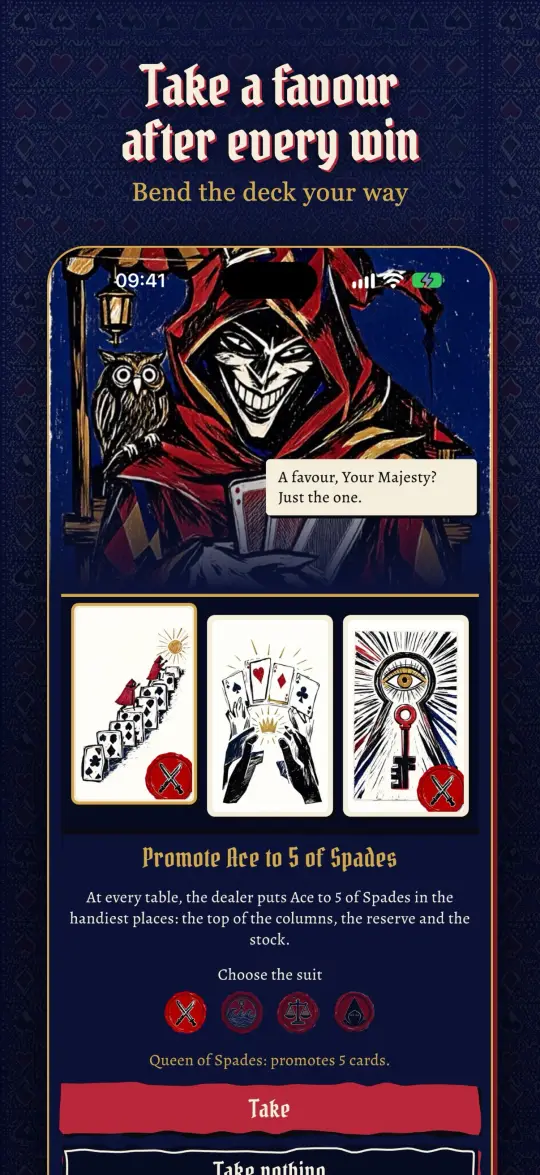
A win opens a choice between favours that bend the deck your way. Everything you build dies with the run.
-
The interregnum
After the four kings, the throne is empty. Two Jokers guard it, and their rules only show at the table.
The genre
What a roguelike solitaire is
Interregnum is a roguelike solitaire game: the patience games you already know, dealt as one run that you win or lose whole. A solitaire app gives you one deal at a time and an undo button, and nothing carries from one game to the next. Here every table is a step in a run of twenty to forty minutes, the rules change with each court, and a lost table ends the run. There are no lives and no retries.
It is for people who play solitaire on the bus and wish it asked more of them, and for roguelike players who want a run that fits in one sitting. You do not need to know all twenty games: each table opens with its rules and its challenge, and the challenge is never "finish the game". It is a number to reach: so many cards on the foundations within the move limit, or so many cards cleared from the peaks.
If you were looking for Interregnum the game, not the gap between two reigns, this is it: Interregnum from AM2 Studio, a solitaire roguelike for Android, iOS and Mac, paid once, with no ads and no in-app purchases. The name comes from that gap, which is where the run ends: four Kings toppled, the throne empty, and two Jokers sitting at it.
Trailer
 Watch the trailer on YouTube · 38 s
At the table
Twenty solitaires
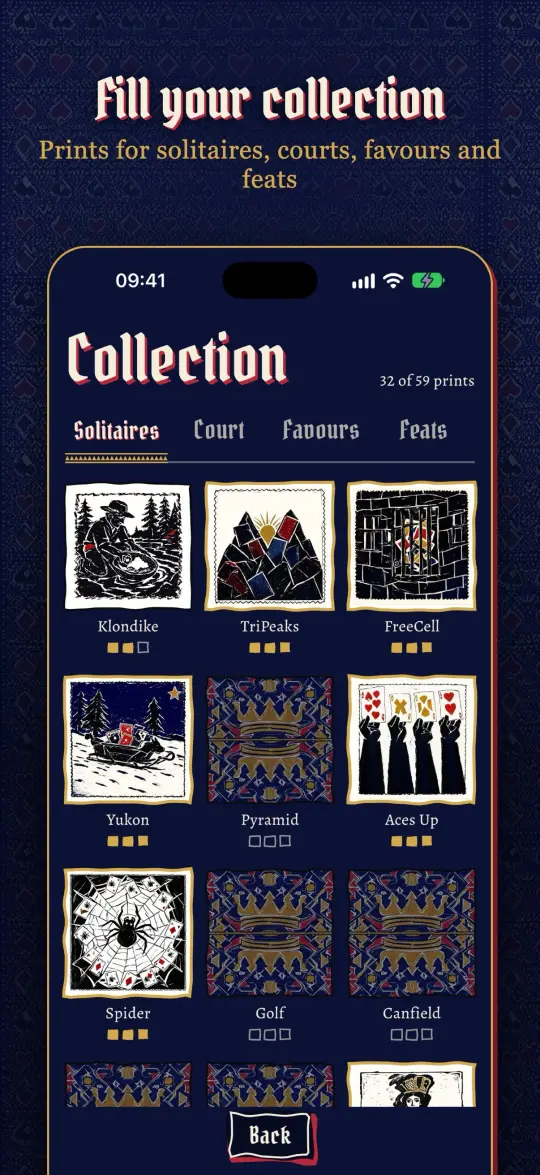
Every table is a classic solitaire
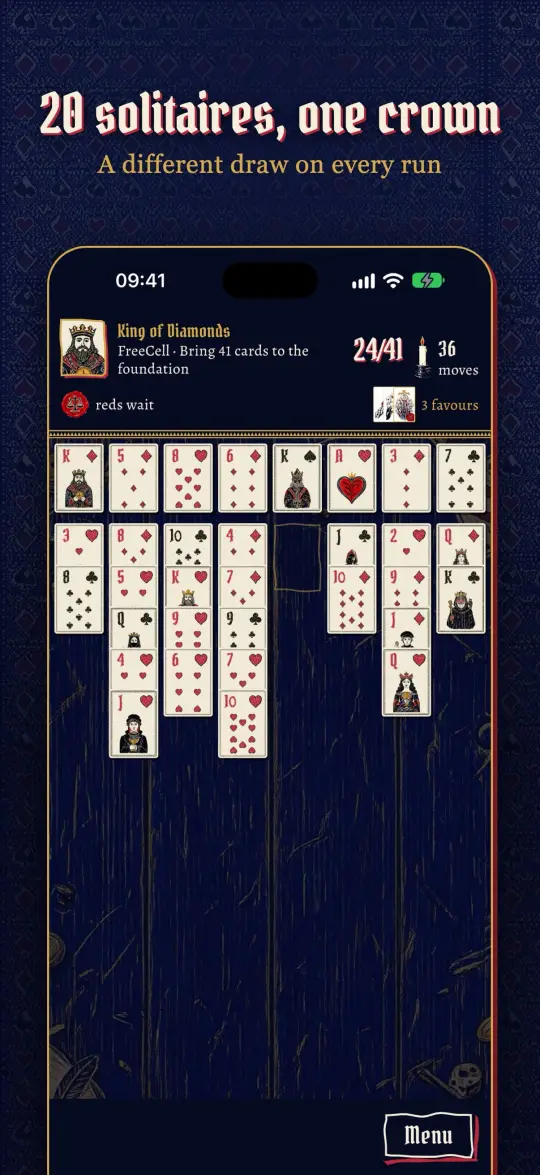
Each run deals a different hand of these twenty. The rules are the classic ones. What Interregnum adds is a challenge at every table, a limit in moves or in stock, and the rule of the court you are playing in.
-
Klondike
The one everyone knows: seven columns and a stock. The challenge is a count of cards on the foundations within a move limit, and it climbs with every court you topple.
-
FreeCell
Every card face up, four free cells, pure planning. A court that drowns cards takes away the one thing FreeCell runs on: seeing everything.
-
Spider
Two suits, ten columns, the longest of the twenty. You do not have to finish it: the challenge is to turn over so many face-down cards within the move limit.
-
Spiderette
Spider with one deck and four suits, dealt in Klondike's seven columns. The same goal, turning face-down cards, on a table small enough for a Jack.
-
TriPeaks
Three peaks, cards one higher or lower than the waste, King and Ace side by side. The challenge counts the cards you clear, or your longest chain without touching the stock.
-
Golf
TriPeaks with everything in view and no wrapping from King to Ace. The question is which column to dig first and when to spend the stock.
-
Pyramid
Pairs that add up to thirteen, and Kings that leave alone. One pass through the stock, and only the cards that leave the pyramid count.
-
Aces Up
Four columns: a card goes when a higher one of its suit tops another column. Two minutes long, and the challenge is how many cards you get rid of.
-
Yukon
Klondike with no stock, where any face-up card moves with everything on top of it, in order or not. Cards to the foundations within a move limit.
-
Canfield
A reserve of thirteen face-down cards and foundations that start at a random rank. Everything you do is to free the top of the reserve, and some tables ask you to empty part of it.
-
Eagle Wing
The Canfield family, with eight wings of three cards each. Every wing is a small cell you spend to reach the trunk, and the stock goes round three times.
-
Baroness
Also called Thirteens. Five columns, tops that add up to thirteen, and a stock that buries all five at once: decide what to take before you deal again.
-
Eight Off
FreeCell with eight cells, four of them full from the start, same-suit sequences and only Kings in an empty column. The cells become a stock you can see.
-
Bristol
Eight fans of three cards and three waste piles that bury three cards at a time. Leave the fans ready to take the next round before you deal it.
-
Baker's Dozen
Thirteen open columns, one card at a time, no cells and no empty columns. Drier than FreeCell: you only dig out a card that already has somewhere to go.
-
Beleaguered Castle
The Aces start on the foundations and every card is face up. The only way out is an empty column, so you clear one early and use it as a cell.
-
Calculation
Four foundations that climb by ones, twos, threes and fours, regardless of suit, and four waste piles you build yourself: the one solitaire where you make your own stock.
-
Betsy Ross
Calculation with a single waste pile and three passes through the stock. What you let go by on this pass, you pick up on the next.
-
Forty Thieves
Two decks, ten columns, one card at a time and a stock that passes once. The hardest of the classics, and so the rare table only a King sits at.
-
Interregnum
The two-deck patience catalogued by David Parlett that gives the game its name: eight foundations climbing from indicator cards, regardless of suit. Only King Nobody, the last Joker, deals it.
Fact sheet
- PlatformsiOS · Android · macOS
- ModelPaid, no ads
- PriceUS$2.99 on Google Play and the App Store
- ConnectionNone
- LanguagesEN · PT · ES · RU
- ReleaseAndroid: 10 Oct 2026 · iOS: 24 Oct 2026 · macOS: Oct 2026
Windows and Linux: coming soon.
At the table
Interregnum came out on Google Play on 10 October 2026 and on the App Store on 24 October 2026, and on the Mac App Store later that month: one purchase covers iPhone, iPad and Mac. Steam and the Microsoft Store are coming soon.

Questions
Questions about Interregnum
Is Interregnum free?
No. It is a paid game: US$2.99 on Google Play and the App Store, paid once. The store shows the price in your currency.
Does it have ads or in-app purchases?
Neither. There are no ads, no coins, no paid undo and nothing to unlock with money. Everything in the game comes with the purchase.
Which platforms is it on?
Android, through Google Play, and iPhone, iPad and Mac, through the App Store, where one purchase covers all three. Versions for Windows and Linux are coming to Steam and the Microsoft Store.
Which languages does it speak?
English, Portuguese (Brazil), Spanish and Russian. You choose on the title screen, and it starts in your system's language.
Does it work offline?
Yes. A whole run plays with no connection, and there is no account to sign in to.
How long is a run?
Twenty to forty minutes, from the first Jack to the last Joker. A lost table ends it sooner.
Is it coming to Windows?
Yes: Windows and Linux, on Steam and the Microsoft Store, at the same US$2.99. There is no date yet. Ask on the support page and you will hear on the day it ships. On a Mac, it is already on the Mac App Store.
Who made it?
AM2 Studio, which is one person: Arthur Monteiro, in Maceió, Brazil. The design, the code, the twenty solitaires and the balancing are his.
Is AI used in the art and music?
Yes, and we would rather say so here. The art was generated with Qwen-Image and the music with ACE-Step, both under licences that allow commercial use. The card sounds are Kenney's free CC0 pack.